Bitspiration 2016: Fireside chat: VC interviewing founder
Presenters detail vulnerability discovery and exploitation in Bitspiration 2016: Fireside chat: VC interviewing founder.
Summary
### Overview At Bitspiration 2016, a venture capital investor hosted a fireside chat with Szymon Niemczura (referred to in the transcript as Shimon), co-founder and CEO of Kontakt.io (contact.io). Ranked by ABI Research as a global leader in beacon infrastructure, Kontakt.io produces smart hardware that delivers physical-world context to smartphones and IoT environments. The discussion explored Niemczura's entrepreneurial beginnings, the transition from bootstrapping to venture funding, managing rapid organizational growth, maintaining cross-border company culture, and building an effective sales engine.
### Key Topics - **Origins and Inspiration**: Niemczura began as a university student doing small IT projects and ran a software house before deciding to pursue hardware with social impact. A discussion with his banker, Tomek, regarding navigational barriers faced by 300 million visually impaired individuals led to prototyping beacon-based contextual smartphone navigation. - **Bootstrapping vs. Venture Capital**: Kontakt.io validated market demand via global pre-orders and bootstrapped for its first year. To scale hardware stock, reduce costs of goods sold (COGS), and gain strategic guidance, the founders raised external capital from Danish venture firm Sunstone Capital. - **VC Dynamics & Integrity**: The discussion contrasted fundraising experiences, noting differences between Western European VCs—who offered transparent, standardized, and constructive term sheets—and certain local investors who attempted to leverage capital to impose unfavorable restrictions on founders. - **Scaling Management and Operations**: Growing from a bootstrap team to over 80 people across international offices required shifting focus from product building to management, coaching, financial budgeting, and structured HR practices. - **Cross-Border Company Culture**: Operating across locations including Krakow, Berlin, New York, Shenzhen, and Guadalajara introduced cultural operational challenges. For instance, Berlin staff maintained typical 9-to-6 business hours, while Krakow engineers with young families often worked from 6 or 7 a.m. to 4 p.m. To bridge offices, Kontakt.io instituted a direct shuttle bus between Krakow and Berlin to encourage team mobility and cultural alignment. - **Prioritizing Sales Early**: Niemczura highlighted that tech startups often mistakenly neglect outbound sales in favor of purely automated marketing. Bringing in an experienced, structured sales lead early helped scale revenue and operational discipline.
### Technical Details & Tooling While focused on business management, the dialogue detailed several operational and technological systems: - **Hardware Infrastructure**: Deployment of Bluetooth beacon hardware providing contextual computing for mobile applications and mobile web. - **Sales & Pipeline Tooling**: Evolving order management from simple spreadsheets to dedicated platforms, integrating tools such as HubSpot and Base CRM (a Krakow-originated tool) to track deal flow and customer data. - **Hiring Oversight**: Implementing structured multi-stage recruitment where the CEO serves as the final interview checkpoint for every hire to preserve company culture.
### Takeaways - **Treat VC Partnerships as Long-Term Relationships**: Selecting investors should be driven by shared values, mentorship, and strategic alignment rather than just cash injections. - **People Over Hardware**: As a startup scales past 20 to 80 employees, the core asset becomes human capital and leadership rather than the physical product itself. - **Invest in Sales Immediately**: Relying solely on organic inbound or self-serve software sales is risky; founders must establish dedicated, structured sales teams early to ensure viable revenue growth. - **Work-Life Balance via Strict Priorities**: Balancing high-growth leadership with family requires deliberate prioritization, treating family as priority number one to avoid burnout and personal sacrifice.
Related talks

PROIDEA Events·46 min
Dark Tangent [Confi2026]
Security researchers examine technical aspects of Jeff Moss - [EN] Fireside Chat with Dark Tangent [Confi2026].

PROIDEA Events·26 min
Engineers explore architecture and security mechanisms for Bitspiration 2015- Founder and President of European Young Innnovators Forum (Kumardev Chatterjee).
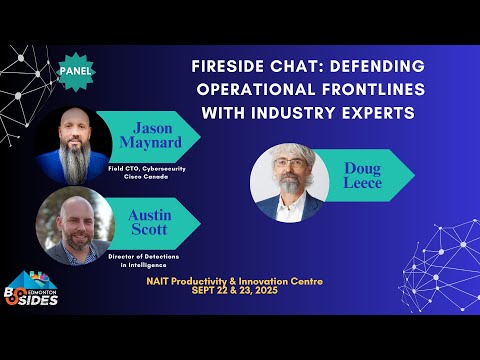
BSides Edmonton 2025·40 min
Fireside Chat: Defending Operational Frontlines with... with Doug Leece, Jason Maynard, Austin Scott
Doug Leece · Jason Maynard · Austin Scott
Security researchers examine technical aspects of Fireside Chat: Defending Operational Frontlines with... with Doug Leece, Jason Maynard, Austin Scott.