From Buffer Overflowing Genomics Tools to Securing
Demonstrating a buffer overflow exploit in popular genomics alignment software (BWA) and steps to secure bioinformatics tools.
Summary
### Software Vulnerabilities in Computational Biology Pipelines At 00:00, Dr. Corey M. Hudson, computational biologist at Sandia National Laboratories, presents research exposing severe memory safety vulnerabilities across genomics software pipelines at the Biohacking Village. Dr. Hudson discusses the growing security risks in biological data processing.
### Fragile Genomics Software Architecture At 08:56, Dr. Hudson examines the ecosystem of open-source bioinformatics tools, including sequence alignment utilities like BWA and SAMtools. He explains that these tools were historically developed by academic researchers focused on computational performance rather than defensive programming or secure memory management.
### Buffer Overflows via Crafted DNA Sequence Files At 18:47, the presentation demonstrates how malformed biological data inputs compromise analytical software. By inserting overly long metadata headers or anomalous nucleotide sequences into FASTQ and FASTA files, researchers trigger classical buffer overflows and memory corruption within genomics parsing engines.
### Operational and Clinical Consequences in Biomanufacturing At 27:43, Dr. Hudson outlines the catastrophic potential of targeted sequence exploitation. Maliciously manipulated genomic files can misdirect sequence alignment algorithms, causing false medical diagnoses or silently disrupting automated gene synthesis pipelines in biopharmaceutical manufacturing facilities.
### Hardening the Bioinformatics Toolchain Concluding between 32:00 and 38:12, Dr. Hudson outlines defensive engineering priorities for the genomics community. He urges developers to transition toward memory-safe languages, implement robust input validation, and integrate automated fuzzing into bioinformatics software development.
(AI summary — Gemini Flash)
Related talks

Village Interviews·< 1 min
A quick spotlight on the Bug Bounty Village highlighting collaborative hunting events, live hacking, and educational sessions at DEF CON 34.
Videos·39 min
Alvaro Muñoz
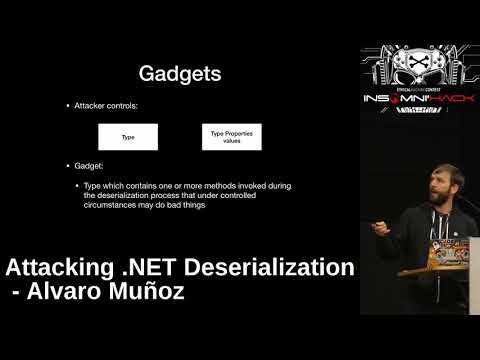
Alvaro Muñoz analyzes Attacking .NET deserialization.

Videos·35 min
Presenters detail vulnerability discovery and exploitation in Hackerzvoice NDH2k15 Talks : Stéfan Le Berre (HEURS) "Vulnerability Research on Windows binaries".