Firmware Decryption: For, and By, the Cryptographically Illiterate
Breaks down practical software and hardware techniques for decrypting obfuscated and encrypted IoT firmware without requiring advanced cryptography math.
Summary
The Rise of Encrypted IoT Firmware
Device manufacturers increasingly encrypt and obfuscate firmware update images to thwart reverse engineering and security audits. However, the cryptographic implementations in embedded devices often contain fundamental flaws.
Locating Keys in Hardware and Bootloaders
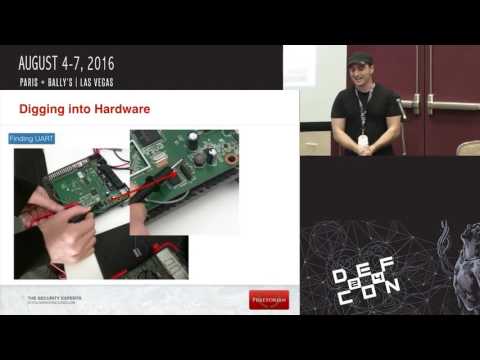
Craig Heffner demonstrates how security researchers can extract decryption keys from physical flash chips, unencrypted bootloader stages (such as U-Boot), and hardware debug interfaces (JTAG/UART) without advanced mathematical cryptanalysis.
Analyzing Flawed Symmetric Key Implementations
Many vendors rely on static, shared AES keys hardcoded across entire product families or employ flawed XOR and substitution ciphers. Reverse engineering previous unencrypted firmware revisions frequently reveals the decryption routines.
Practical Tooling and Unpacking Workflows
Equipped with practical scripts and firmware analysis frameworks, researchers can successfully unpack encrypted vendor updates and inspect embedded binaries for vulnerabilities.
Related talks

Main Stage·41 min
Jeroen 'Jeroen' Domburg
Demonstrates hardware hacking and reverse engineering to run custom Linux kernels and open software on inexpensive USB webcams.

Hardware Hacking Village·51 min
Federico Lucifredi
Provides an introductory primer on hardware reverse engineering, circuit analysis, and common physical attack vectors.
IoT Village·47 min
A practical guide to extracting firmware, identifying debug ports, and discovering zero-day vulnerabilities in consumer embedded devices.