The Black Art of Wireless Post Exploitation
Bypassing port-based NAC with rogue access points to pivot past wireless perimeter defenses.
Summary
Wireless Enterprise Security
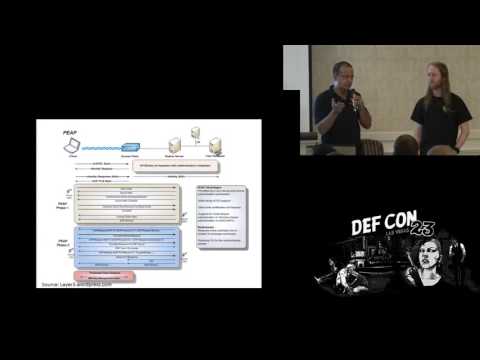
Most forms of WPA2-EAP have been broken for nearly a decade. EAP-TTLS and EAP-PEAP remain susceptible to evil twin attacks, yet most enterprises rely on these technologies. The secure alternative, EAP-TLS, is arduous to implement.
NAC as Compensating Control
Organizations use port-based NAC appliances to prevent attackers from pivoting after wireless compromise. This approach assumes reactive security balances security and accessibility.
Assumption Challenge
A fundamental assumption is that EAP functions exclusively as perimeter defense. The presentation challenges this through a novel rogue access point attack that bypasses port-based access control mechanisms.
Pivoting Through Wireless
The attack demonstrates that reactive wireless security approaches are inadequate alternatives to strong physical layer protections like WPA2-EAP with EAP-TLS. Organizations must implement preventive controls, not rely on network segmentation after wireless compromise.
Related talks

Main Stage·47 min
Michael Sutton · Pedram Amini
Michael Sutton and Pedram Amini explores hacking the invisible network at DEF CON 11, examining rogue-access-points and practical defenses.

RF Village·26 min
m0nkeydrag0n
Investigates in-flight commercial airline Wi-Fi infrastructure and Evil Twin rogue access points, detailing SOC analyst detection strategies using ADS-B telemetry.
Village Presentations·1 hr 23 min
Vivek Ramachandran · Thomas Dotreppe
Vivek Ramachandran and Thomas Dotreppe demonstrate weaponizing rogue RADIUS access points to exploit WPA/WPA2 Enterprise PEAP and EAP-TTLS networks.