Getting Started Building an IoT Hardware Hacking Lab
Guides defenders and researchers through assembling an affordable hardware hacking workbench with essential tools and equipment.
Summary
Deral Heiland, IoT Research Lead at Rapid7, delivers a comprehensive, practical walkthrough on building an IoT hardware hacking and firmware analysis lab suitable for beginners through advanced practitioners [00:00]. He begins by addressing workspace ergonomics and physical disassembly essentials, covering screwdrivers (security bits, spudgers), precision tweezers, digital microscopes, and borescopes or USB pen cameras used to inspect confined interior spaces without destroying device enclosures [14:20].
Heiland dives into soldering and desoldering tools, discussing temperature-controlled irons (Weller stations, TS100 portable irons), hot air rework stations, solder flux, desoldering braid, and low-melt bismuth alloys like Chip Quik for removing delicate surface-mount components [07:03]. Moving to hardware interfaces, he explains how to extract firmware from flash memory chips using programmers like the TL866II Plus, SOIC test clips, and low-cost CH341A adapters [36:28]. For communications analysis and protocol reverse engineering, he evaluates budget-friendly USB-to-UART serial adapters, logic analyzers (comparing 8-channel $12 clones running Sigrok/PulseView against high-end Saleae units) [44:22], and hardware debuggers like the SEGGER J-Link and ST-Link for ARM JTAG/SWD interfaces [51:21].
The session includes practical lab techniques, such as using 30 AWG wire-wrapping wire and UV-cure solder mask or hot glue to reinforce micro-soldered tap wires against accidental tearing [01:06:02]. Heiland concludes by advising researchers on how to source cheap consumer targets from thrift stores and online marketplaces to practice board identification, pinout tracing, and firmware dumping.
(AI summary — Gemini Flash)
Related talks

IoT Village·1 hr 3 min
Deral Heiland
Details techniques for dumping raw NAND flash chips, reconstructing wear-leveled blocks, and recovering embedded filesystems.

IoT Village·1 hr 1 min
Matthew Byrdwell
Presents an embedded hardware research case study dissecting device security architecture and unexpected failure modes.
IoT Village·47 min
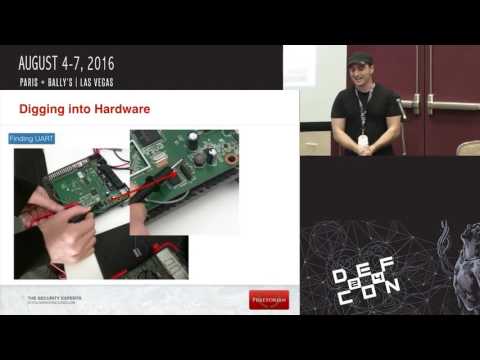
A practical guide to extracting firmware, identifying debug ports, and discovering zero-day vulnerabilities in consumer embedded devices.