I Am Packer and So Can You
Mike Sconzo breaks down the mechanics of executable packers, demonstrating how to write custom PE packers from scratch to evade static detection.
Summary
Architecture and Background
Automating packer and compiler/toolchain detection can be tricky and best and downright frustrating at worst. The majority of existing solutions are old, closed source or aren’t cross platform.
Vulnerability Analysis
Originally, a method of packer identification that leveraged some text analysis algorithms was presented. The goal is to create a method to identify compilers and packers based on the structural changes they leave behind in PE files.
Exploitation and Demonstrations
This iteration builds upon previous work of using assembly mnemonics for packer detection and grouping. New features and analysis are covered for identification and clustering of PE files.
Remediation and Defensive Strategies
Mike Sconzo has been around the Security Industry for quite some time, and is interested in creating and implementing new methods of detecting unknown and suspicious network activity as well as different approaches for file/malware analysis. This includes looking for protocol anomalies, patterns of network traffic, and various forms of static and dynamic file analysis. He works on reversing malware, tool creation for analysis, and threat intelligence. Currently a lot of his time is spent doing data exploration and tinkering with statistical analysis and machine learning.
Related talks

Main Stage·42 min
Laurie Kirk
Laurie Kirk unveils runtime manipulation techniques in native C++ via JNI to alter Android execution flow, defeating emulators and decompilers.

Black Hat·57 min
Security researchers examine technical aspects of Revoke-Obfuscation: PowerShell Obfuscation Detection (And Evasion) Using Science.
Main Stage·39 min
Agostino Panico
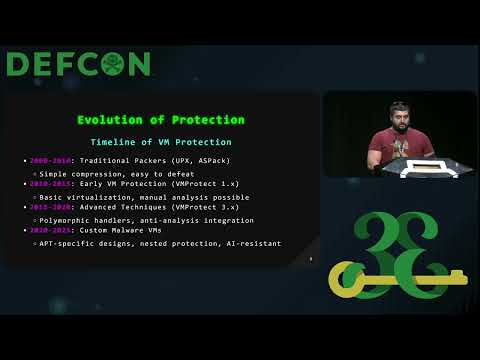
Presents a dynamic analysis framework for automatically unpacking and deobfuscating nested virtual-machine-based software protectors used in advanced malware.