PLNOG17 - Leonir Hoxha - Next Generation Network Architecture
Segment Routing examines PLNOG17 - Leonir Hoxha - Next Generation Network Architecture.
Summary
## Overview Leonir Hoxha presents a comprehensive introduction to Segment Routing (SR) and its application in next-generation service provider network infrastructure. SR was developed to address operator requests for simpler, more efficient, and SDN-ready network architectures. Though still in IETF draft stages (starting in 2013, now with 10+ drafts), SR already has numerous implementations and satisfied customers reporting high satisfaction.
## Technical Foundation Segment Routing is a source routing technology that fundamentally changes how networks forward traffic. Unlike traditional MPLS approaches, SR stores routing state in the packet header rather than across network infrastructure. The control plane uses standard IGP protocols (IS-IS, OSPF) with SR extensions, while the data plane remains unchanged—still using MPLS label forwarding, now called Segment IDs. Two forwarding variants exist: SR-MPLS (covered in this talk) and SRv6.
SR operates with three basic label operations: Push (add a segment), Continue (swap to the next segment), and Pop/Next (remove the label). The technology introduces two segment types: Global Segments, understood by all network devices via the Segment Routing Global Block (SRGB—typically labels 16,000 to 24,000), and Local Segments, significant only to the generating device for outgoing interfaces. Critical segments include Node Segments (Prefix Segments) identifying specific devices via loopback interfaces, and Adjacency Segments enabling explicit path selection through direct links.
## Key Use Cases **Topology Independent LFA (TI-LFA)**: Achieves 100% failure coverage by pre-calculating backup paths for each prefix segment. When links fail, devices automatically push backup segments onto packets for rerouting without complex state management or additional configuration beyond enabling LFA in the IGP.
**Disjoint Path Routing**: Uses Anycast Segment IDs to establish geographically diverse paths. Assigning identical Anycast IDs to devices across separate planes (e.g., routes through different countries) enables traffic engineering to avoid shared failure points.
**Centralized SDN Traffic Engineering**: Leverages BGP Link State (BGP-LS) and Path Computation Elements (PCE) giving SDN controllers complete network visibility. Applications request specific paths—low-latency or bandwidth-constrained routes—via controller APIs, which automatically program the network without manual configuration.
## Operational Benefits Key advantages include low OPEX and CAPEX due to simplified architecture; ECMP-aware automatic load balancing across equal-cost paths; micro-loop avoidance during convergence; smooth incremental deployment allowing coexistence with traditional LDP networks via mapping servers; and full SDN integration for dynamic orchestration. Minimal configuration—essentially two commands to enable SR within IGP processes—is required. Explicit traffic engineering eliminates RSVP-TE midpoint state management, centralizing state only at network edges or SDN controllers.
## Current State Though not yet official standard, SR has progressed from initial draft (2013) through multiple implementation stages. Vendors including Cisco offer production deployments. Customer deployments highlight reduced operational burden and future-proof automation-ready infrastructure.
Related talks

PROIDEA Events·44 min
Engineers explore architecture and security mechanisms for PLNOG15 - Evolution of DWDM optical network architecture (Fedorowski, Pawelec).

DIGIT·40 min
Expo 2023 | Ryan McConechy: Demystification of Zero Trust Network Architecture.
Videos·48 min
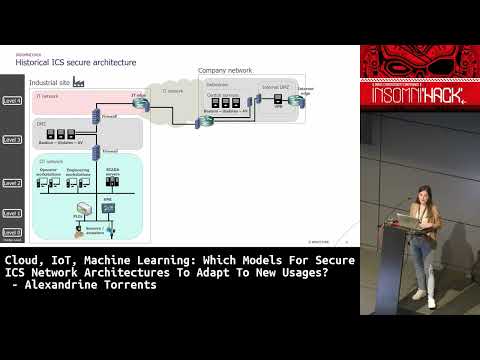
Presenters detail vulnerability discovery and exploitation in Which Models For Secure ICS Network Architectures To Adapt To New Usages? by Alexandrine Torrents.