Drive It Like You Hacked It: New Attacks and Tools to Wirelessly Steal Cars
Samy Kamkar introduces RollJam and other low-cost hardware devices that intercept rolling-code wireless key fobs to remotely unlock and access vehicles.
Summary
Vulnerabilities in Automotive Rolling Codes
Samy Kamkar investigates the cryptographic architectures governing wireless keyless entry systems for modern automobiles and garage doors. While early systems utilized static radio codes vulnerable to simple replay attacks, modern vehicles rely on rolling codes (such as Keeloq) where each transmission uses a pseudo-random code that expires upon use.
Architecture and Mechanics of the RollJam Attack
Kamkar introduces RollJam, a low-cost, pocket-sized hardware device built using inexpensive radio transceivers and microcontrollers. RollJam intercepts wireless key fob signals by executing a simultaneous jamming and sniffing attack: when the car owner presses the unlock button, RollJam jams the receiver with noise while recording the valid rolling code.
Stealing Unused Rolling Codes in Real Time
When the victim presses the key fob a second time assuming the first press failed, RollJam repeats the process: it jams and records the second code while instantly replaying the first recorded code. The vehicle unlocks normally, leaving the driver unsuspecting, while the attacker retains a valid, unspent rolling code capable of unlocking the car or garage later.
Industry Countermeasures and Cryptographic Upgrades
The presentation demonstrates the attack against multiple automotive manufacturers and garage door brands. Kamkar urges automotive engineers to implement time-based code expiration, dual-frequency validation, and challenge-response cryptographic protocols to protect vehicular access control against synchronized RF manipulation.
(AI summary — Gemini 3.8 Flash)
Related talks
Main Stage·38 min
Joseph Gabay
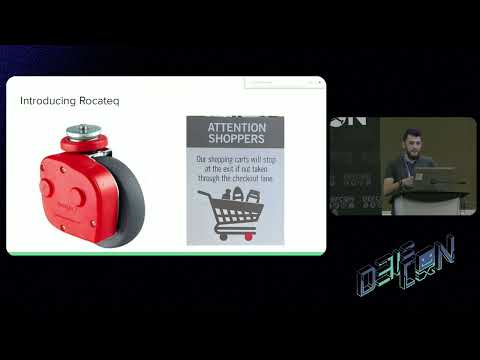
Reverse engineers electronic shopping cart containment wheels, capturing ultra-low-frequency and 2.4 GHz RF signals to unlock wheel braking mechanisms.

Auto Hacking Village·13 min
Using the Yard Stick One sub-1GHz wireless transceiver to capture, analyze, and replay signals from automotive key fobs.

IoT Village·46 min
Analyzing multidimensional RF and network attack vectors against commercial drones, alongside practical defensive countermeasures.