The Hugh Thompson Show: Dr. Sebastian Thrun
Engineers explore architecture and security mechanisms for The Hugh Thompson Show: Dr. Sebastian Thrun.
Summary
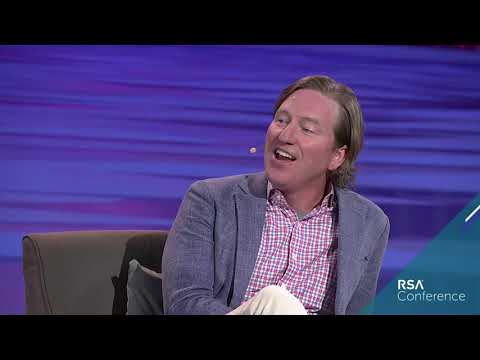
### Overview In this session of *The Hugh Thompson Show* at RSA Conference, host Hugh Thompson interviews Dr. Sebastian Thrun, founder and president of Udacity, CEO of Kittyhawk, and founder of Google X. Rather than focusing solely on worst-case failure modes or dystopian 'Skynet' narratives common among security professionals, the discussion examines the transformative, optimistic potential of artificial intelligence (AI). The conversation highlights AI as a force amplifier for human intellect, the societal shifts accompanying automation, the future of work, and the irreplaceable nature of human soft skills like empathy and creativity.
### Key Topics - **Democratizing Education:** Thrun outlines Udacity's mission to double global GDP by democratizing access to education worldwide, partnering with tech leaders like Google and Facebook. Thompson announces a $50,000 scholarship donation from RSA Conference toward Udacity's newly launched cybersecurity Nanodegree. - **Historical Parallels and Automation:** Drawing a comparison to the Industrial Revolution and the steam engine—which shifted farming from employing the vast majority of people to under two percent today—Thrun argues that modern repetitive office tasks (from data entry to document discovery) will be taken over by AI. - **Human Augmentation and Brain Prosthetics:** Rather than replacing humanity, AI is positioned as a cognitive prosthetic that eliminates mundane labor and frees humans to focus on creative, high-value problem-solving. - **Essential Future Skills:** As repetitive and analytical tasks automate, Thrun emphasizes that curiosity, a growth mindset, grit, teamwork, and social-emotional skills will become the most valuable attributes in the workforce. - **The Role of Security Professionals:** Thompson concludes by noting that security professionals must understand technological failure modes preemptively so they can champion and safely guide the adoption of transformative technologies.
### Technical Details - **Deep Learning in Healthcare:** Thrun references a Stanford study where deep learning was trained on 129,000 body images to detect skin cancer, achieving diagnostic accuracy on par with or better than top board-certified dermatologists. - **High-Leverage Software Development:** As an example of modern technological leverage, Thrun cites WhatsApp scaling to over one billion users with a team of roughly 50 people before its acquisition by Facebook.
### Takeaways - Automation should not be viewed as human obsolescence, but as relief from repetitive work, enabling reallocation of human effort toward empathetic and creative roles (e.g., teaching, nursing, and innovation). - Mindsets characterized by humility, rapid iteration, admitting errors, and continuous learning are critical differentiators for entrepreneurs and technologists. - Cybersecurity experts have a dual responsibility: to anticipate and mitigate the vulnerabilities of AI systems while actively facilitating their societal benefits.
Related talks

RSAC Cybersecurity·4 min
Christopher Lloyd
Presenters detail vulnerability discovery and exploitation in The Hugh Thompson Show: Quantum Edition with Christopher Lloyd.

RSAC Cybersecurity·34 min
Analysts investigate attack surfaces and defenses concerning The Hugh Thompson Show: Quantum Edition.
RSAC Cybersecurity·1 hr 8 min
Security researchers examine technical aspects of Hugh Thompson Show: Exploring Information Disorder.