What’s Really in the Box? The Case for Hardware Provenance and HBOMs
Makes the case for Hardware Bills of Materials (HBOMs) to trace semiconductor provenance, detect component cloning, and secure hardware supply chains.
Summary
The Blind Spot in Hardware Supply Chains
While Software Bills of Materials (SBOMs) have gained significant traction for software transparency, hardware component provenance remains an opaque black box. Counterfeit chips, unauthorized silicon revisions, and obscure fabrication origins create systemic security risks across critical infrastructure.
Limitations of Traditional Procurement BOMs
Traditional bills of materials track basic procurement part numbers and assembly logistics, but fail to record manufacturing origin, silicon provenance, or cryptographic component integrity. They cannot detect unauthorized hardware modifications or counterfeit chips.
The Hardware Bill of Materials (HBOM) Initiative
The HBOM initiative establishes standardized formats and tooling to track hardware component origins, silicon design provenance, and supply chain lineage from fabrication through final device assembly.
Empowering Risk-Informed Procurement
Adopting HBOMs enables government agencies and critical infrastructure operators to audit hardware supply chains, verify component integrity, and make informed risk decisions without relying solely on geographic trade restrictions.
Related talks
Main Stage·33 min
Anthony Rose · Jake Krasnov
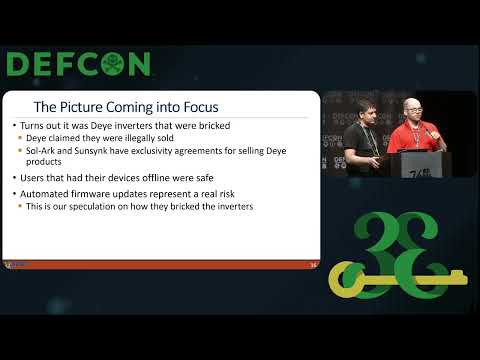
Uncovers widespread firmware backdoors and hardware vulnerabilities in commercial solar inverters and energy management gateways across global supply chains.

Creator Stage·21 min
Larry Pesce
Demonstrates hardware disassembly, SPI flash extraction, and JTAG interfacing to build an accurate Software Bill of Materials for an IoT Wi-Fi router.

Creator Stage·31 min
Emma Stewart
Analyzes supply chain and cybersecurity policy challenges when integrating foreign-sourced components into clean energy infrastructure.