[WOOT2021] Sensor Security
Industry experts analyze emerging threats surrounding [WOOT2021] Sensor Security.
Summary
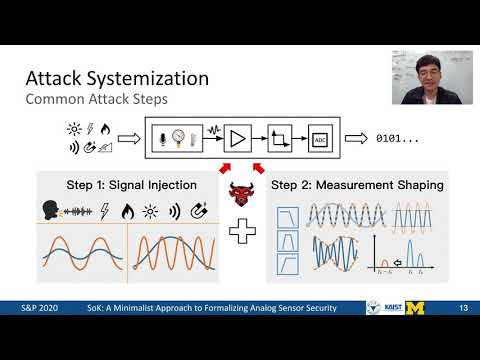
### Overview In this WOOT 2021 keynote presentation, Dr. Sara Rampazzi, an assistant professor at the University of Florida and member of the Florida Institute for Cybersecurity, examines sensor security within the growing ecosystem of the Internet of Everything (IoE). As autonomous cyber-physical systems and artificial intelligence increasingly make critical decisions without direct human supervision, they fundamentally rely on sensors to perceive their surroundings. However, physical sensors and electronic components possess vulnerabilities stemming from physical phenomena that allow external analog signals—such as light, sound, and electromagnetic interference—to alter device behavior and manipulate higher-level software and machine learning models without requiring conventional software compromise or malware.
### Key Topics - **The Internet of Everything and Autonomous Decisions**: How connected devices, smart homes, healthcare devices, and autonomous vehicles rely on sensors to gather environmental data for automated actions. - **Sensor Exploitation Mechanisms**: Five core physical factors exploited by attackers: coupling (e.g., resonant frequency EMI), non-linearities in hardware components, intermodulation/frequency generation, predictable periodic behavior/timing, and over-sensing/accidental transduction. - **Signal Injection via Light (MEMS Microphones)**: Demonstrating how voice-controllable systems (Google Home, Amazon Echo, Facebook Portal, smartphones, tablets) can be commanded using amplitude-modulated lasers. - **Downstream System Compromise**: Leveraging compromised voice assistants to execute actions across connected IoT ecosystems, such as unlocking smart locks, opening garage doors, and starting cars. - **Autonomous Vehicle Perception Spoofing**: Attacking LiDAR systems using precise timing and relay attacks to feed fake echo signals into obstacle-detection systems, fooling machine learning perception frameworks (like Baidu Apollo). - **Hardware-Software Co-Design for Defense**: Moving past isolated software patches and appreciating the physical reality of hardware to engineer resilient defenses.
### Technical Details - **MEMS Microphone Light Vulnerability**: MEMS microphones contain a movable diaphragm and a stationary back plate forming a parallel-plate capacitor, coupled to an onboard ASIC. Due to photoacoustic and photoelectric effects across the membrane and ASIC, incoming light irradiance induces measurable voltage changes. Modulating the current driving a laser diode with an amplified audio signal creates an amplitude-modulated light beam that translates into clear voltage signals mimicking acoustic voice commands. - **Attack Range and Penetration**: Using optics and a low-power 5 milliwatt laser pointer setup (achievable with setups as cheap as ~$300), commands were successfully delivered through windows and between buildings up to 110 meters away across more than 17 tested devices. - **Compounding IoT Flaws**: Light injection attacks succeeded in manipulating downstream infrastructure due to weak default configurations, lack of authentication on multi-user speakers, bypassable voice personalization (via text-to-speech spoofing), routine automations bypassing PIN entry, and lack of brute-force rate limiting on spoken PINs. - **LiDAR Spoofing and Adversarial Injection**: LiDAR determines distance by timing reflected laser pulses. By exploiting sensor periodicity, synchronized relay attacks injected false reflections, projecting an adversarial horizontal line that tricked the Apollo autonomous driving perception model into detecting nonexistent obstacles, stopping simulated and moving vehicles.
### Takeaways - Sensors serve as both the primary target and an entry medium to compromise all layers of a system, from silicon to machine learning models. - Traditional security countermeasures (cryptography, memory safety, software patching) cannot remediate physical over-sensing vulnerabilities once hardware is deployed. - Mitigations require a layered defense combining hardware modifications (e.g., non-exposed acoustic ports, shielded boards), multi-sensor input validation, and anomaly detection algorithms. - Security researchers, hardware manufacturers, and software engineers must break down domain silos and treat hardware and software as a single unified system to anticipate emerging attacks.
Related talks

IEEE Symposium on Security and Privacy·20 min
Security researchers examine technical aspects of SoK: Social Cybersecurity.

IEEE Symposium on Security and Privacy·23 min
Industry experts analyze emerging threats surrounding [WOOT2021] Evaluation of the Executional Power in Windows using Return Oriented Programming.
IEEE Symposium on Security and Privacy·17 min
Analysts investigate attack surfaces and defenses concerning SoK: A Minimalist Approach to Formalizing Analog Sensor Security.