Surviving 51% Attacks: Proof-of-Work Consensus Resiliency
Yaz Khoury examines 51% hashpower attacks on Proof-of-Work blockchains, analyzing chain reorganization defenses and checkpointing mechanisms.
Summary
Yaz Khoury presents an in-depth technical post-mortem on 51% consensus attacks in proof-of-work blockchains, examining the multi-million-dollar double-spend attacks launched against Ethereum Classic (ETC) in August 2020 and the consensus innovations developed to prevent future reorganizations.
[11:33] Khoury reviews the mechanics of 51% attacks, explaining how an adversary possessing a majority of mining hash power can secretly mine an alternate chain history ("shadow mining") while submitting deposits to cryptocurrency exchanges on the public chain. Once the exchange credits the funds, the attacker releases their longer private chain, triggering the Nakamoto consensus longest-chain rule to reorganize the blockchain, invalidate the original deposit transactions, and execute double-spends.
[23:33] The presentation analyzes the August 2020 attacks against ETC, where attackers rented hash power from platforms like NiceHash to execute massive reorganizations exceeding 4,200 blocks. Khoury details the emergency defensive response, including node client patches, cooperation with mining pools, and the implementation of Modified Exponential Subjective Scoring (MESS) [35:00]. He explains how MESS introduces a subjective penalty that artificially scales the required mining difficulty for long-depth reorganizations, rendering rented hash attacks economically irrational and restoring consensus resiliency to smaller proof-of-work networks.
(AI summary — Gemini Flash)
Related talks

Blockchain Village·1 hr 3 min
Colin Cantrell
Colin Cantrell presents an alternative cryptographic and architectural approach to solving the blockchain trilemma of scalability, decentralization, and security.
Blockchain Village·38 min
Shinchul Park · Seungjoo Kim
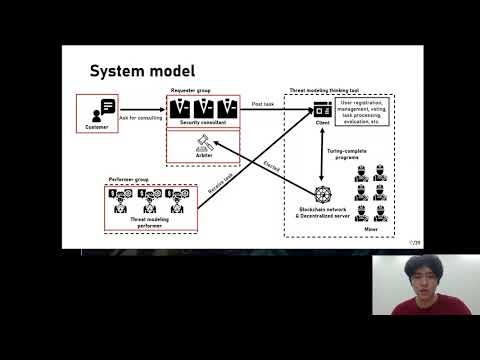
Korea University researchers Shinchul Park and Seungjoo Kim explore using blockchain consensus as a collaborative framework for multi-stakeholder threat modeling.

Blockchain Village·52 min
Ron Stoner
Covers architectural security patterns, Tendermint consensus auditing, and threat vectors across the Cosmos blockchain ecosystem.